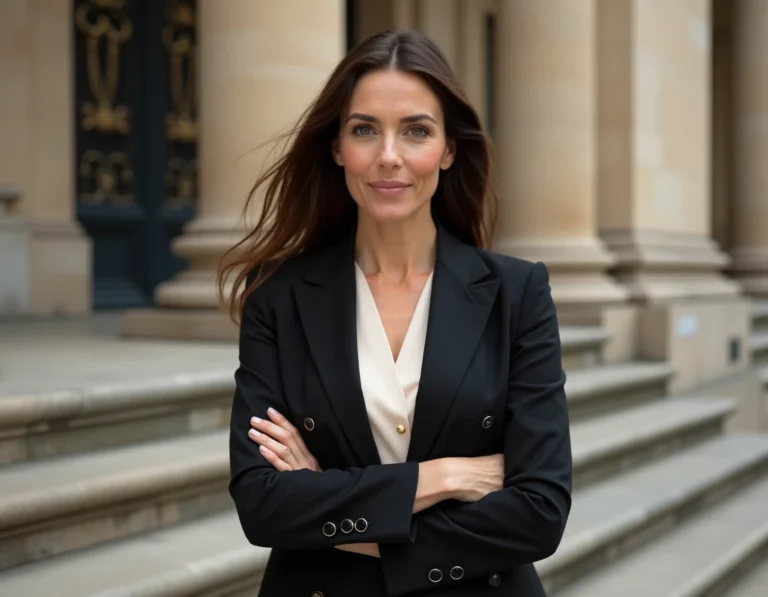
Élodie Huchard is a journalist and commentator on CNews, appearing on air in political analysis and current affairs formats. Despite this regular media exposure, no verified information circulates about her family life, her children, or her partner. This lack of public data raises a concrete question: does the silence of a media personality regarding their private sphere deserve to be filled by public curiosity?
Digital Protection of Journalists Against Doxxing
Élodie Huchard’s discretion is not merely a communication choice. It is set against a backdrop where attempts at doxxing targeting editorial teams of news channels have multiplied since mid-2025, according to interviews published in Le Monde in April 2026. CNews commentators have reported off the record that this pressure has led to internal training on private cybersecurity.
Publishing personal details, even innocuous ones, provides entry points for malicious individuals. A child’s first name, a residential neighborhood, a school: each fragment can be cross-referenced to reconstruct an exploitable profile. For a journalist covering divisive political topics, this exposure represents a concrete, not theoretical, risk.
The question of Élodie Huchard’s privacy and her family directly touches on this security issue, far beyond mere media curiosity.

Article 9 of the Civil Code and the 2026 Law on Digital Privacy
The French legal framework protects the privacy of every individual, including public figures. Article 9 of the Civil Code has established this principle for decades. The law n°2026-142 of April 18, 2026 has strengthened this protection by extending provisions against digital intrusions into the private lives of public figures.
This law has been applied for the first time to investigations concerning journalists. The signal is clear: television fame does not create a right to access an individual’s family sphere. Disseminating non-consensual information about a journalist’s children or partner now exposes one to heavier penalties than before.
What the Law Changes Practically
- Digital intrusions (targeted searches, publication of cross-referenced personal data) are classified more severely, even in the absence of defamation
- Protection explicitly applies to media figures, filling a previous legal gray area where only political figures benefited from established case law
- Platforms hosting intrusive content can be put on notice within shorter timeframes
For internet users searching for information about Élodie Huchard’s children or her family circle, this regulatory evolution sets a clear boundary between legitimate curiosity and invasion of privacy.
Media Discretion and Journalistic Credibility
Élodie Huchard chooses a total opacity regarding her personal life. This positioning distinguishes her from other French journalists. Léa Salamé, for example, partially opened her intimacy in 2024 through a family podcast. The two approaches coexist, but their effects on professional perception differ.
According to a study by the IFJ on fifty French journalists, published in February 2026, discretion about private life tends to enhance perceived credibility among the public. The reasoning is simple: a journalist who reveals nothing personal offers less ground for accusations of bias or conflict of interest.
The Downside of Total Discretion
This strategy has a documented side effect. The information void created by silence fuels speculation. When no verified data exists, rumors, conspiracy theories, and fake profiles take over. Websites publish “revelations” without sources, forums elaborate on hypotheses, and readers struggle to distinguish fact from fantasy.
Élodie Huchard’s resilience against personal attacks partly relies on this absence of exploitable material. Nothing to distort, nothing to instrumentalize. But this same absence creates a vacuum that other, less scrupulous actors fill in their own way.

Online Rumors About Élodie Huchard: How to Distinguish Truth from Falsehood
A search for information about Élodie Huchard’s children or partner leads to sites whose business model relies on traffic generated by curiosity. These pages use catchy titles (“what her interventions reveal,” “decoding her discretion strategy”) but contain no sourced information.
No public statement from Élodie Huchard confirms the existence, number, or identity of her children. No public registry, no interview, no accessible document provides this data. Content claiming otherwise fabricates certainty from nothing.
Some reflexes can help assess the reliability of an article about a media personality’s private life:
- Check if the article cites a primary source (direct interview, official document, statement from the individual) or if it relies on “according to our information” without attribution
- Observe if the site systematically publishes similar content about other personalities, a sign of industrial production of speculative content
- Look for the information elsewhere, in a recognized media outlet, with an identifiable journalistic signature
The right to curiosity exists. The right to verified information does too. Between the two, the boundary lies in the source, not in the volume of Google results.
Élodie Huchard’s situation illustrates a tension inherent to opinion journalists in France: being visible enough to exist in public debate, discreet enough to protect her family, and legally equipped enough for that discretion to be respected. The 2026 law provides a framework. The rest relies on each individual’s discernment in the face of a search engine.