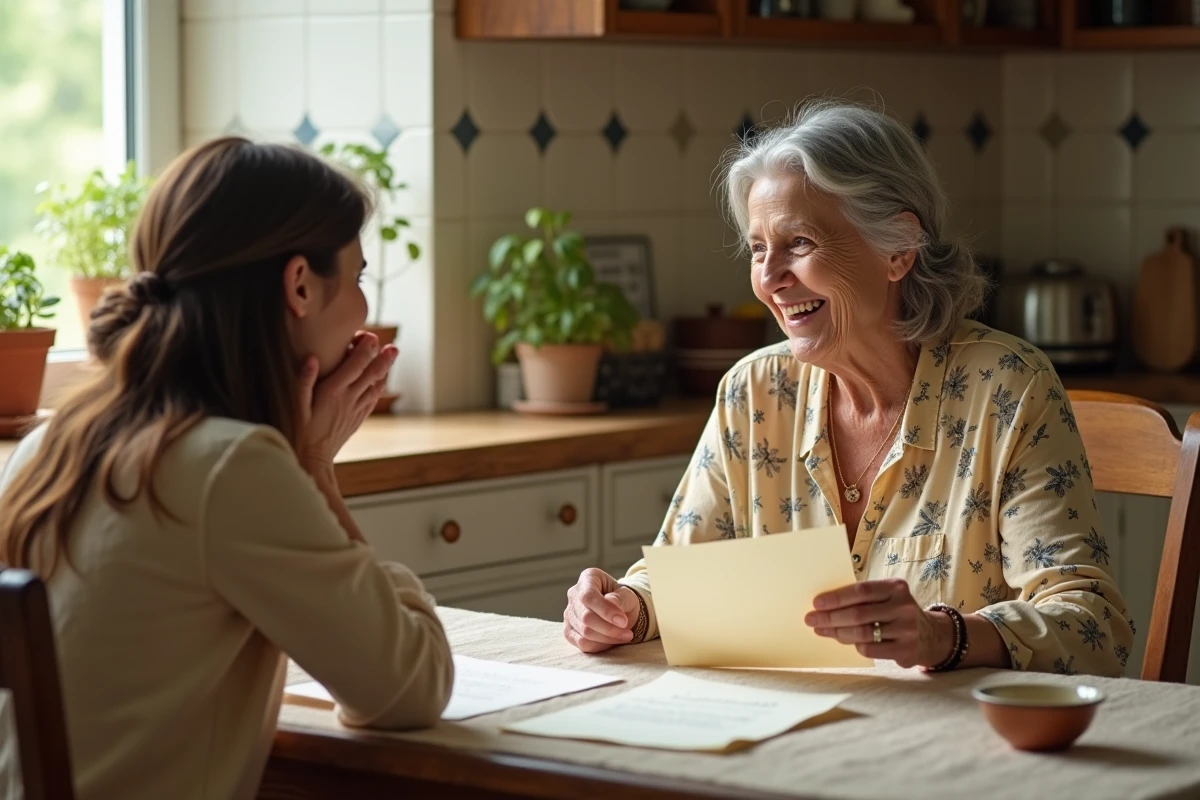
Messages between a grandmother and her granddaughter hold a special place in family correspondence. Between tender declarations and self-deprecating humor, these short texts circulate on social media, birthday cards, and WhatsApp conversations. Their popularity stems from a simple mix: the sincerity of the intergenerational bond and a humor that only a grandma can afford.
Grandma Humor and Technology: An Expanding Collection of Quotes
Competitors compile lists of classic sentimental phrases. However, the most fertile ground for a grandma’s quote for her granddaughter lies elsewhere: in technological self-deprecation.
In recent years, senior accounts on TikTok and Instagram showcase grandmothers who intentionally play on their disconnect with digital codes. Misused emojis, endless voice messages, confusion between apps: grandmas’ technological self-deprecation generates more shares than sentimental quotes. Community managers specializing in the silver economy note a significant engagement gap between these two registers.
This type of humor works because it is authentic. A grandma who writes, “I sent a heart to your dad instead of you, he’s going to think I love him more,” doesn’t need a literary filter. The clumsiness becomes the message.

Touching Quotes from Grandma to Granddaughter: What Distinguishes a Sincere Message from a Hollow Phrase
A touching text is not recognized by its length or sophisticated vocabulary. It is recognized by its precision. The messages that circulate most between generations share one characteristic: they refer to a moment experienced together.
“You were three years old and you refused to let go of my hand at the market” is worth more than “you are the light of my life.” The first sentence evokes a sensory memory. The second could apply to anyone.
Three Criteria for a Message that Truly Touches
- A concrete detail: a place, an object, a shared habit. The message anchors the relationship in reality rather than in the abstract.
- A recognizable voice: the grandma’s vocabulary, her regional expressions, her slightly outdated phrases. It is precisely this linguistic disconnect that creates emotion.
- A brief length: the most frequently shared quotes on social media fit into one or two sentences. A short, personal message leaves a stronger impression than a long, generic text.
Personalized gift platforms have understood this well. “Grandma tells” books or engraved cushions offer limited text spaces, forcing the essence to come through.
Messages with Dual Voices: The Rising Format of Grandma and Granddaughter
The majority of existing content operates on a one-way scheme. The grandma speaks, the granddaughter listens, or vice versa. Since 2023, a different format has emerged on social media: the cross-message where both generations write or read together.
The principle is simple. The grandmother writes what she thought of her granddaughter at her birth, then the granddaughter writes what she thinks of her grandma today. Both texts are read aloud on camera or presented side by side in the same image.
This “before/now” format works particularly well for several reasons. It shows the evolution of the relationship over time. It gives voice to both parties, creating emotional symmetry. And it lends itself to both tenderness and humor when the grandma describes her granddaughter as a baby with quirky vocabulary.
Where to Use This Format
There are plenty of occasions: Mother’s Day, birthdays, Grandparents’ Day, or even without a specific reason. Messages sent without a precise occasion often surprise the most. A text sent on an ordinary Tuesday carries more emotional weight than an obligatory card on the big day.

Writing a Message of Love and Humor for Your Granddaughter: Pitfalls to Avoid
The first pitfall is the cliché. “You are my sunshine,” “you light up my days”: these phrases have been used so much that they have lost their emotional charge. A recognized cliché produces the opposite effect of what is intended.
The second pitfall concerns poorly measured humor. A grandma who jokes about her age or memory hits the mark. A grandma who forces a joke borrowed from social media sounds false. Intergenerational humor works when it comes from shared experiences, not from a copied-and-pasted meme.
- Avoid quotes attributed to famous authors without verification: many “quotes from Victor Hugo about grandmothers” were never written by him.
- Do not mix multiple tones in the same message: a text that starts in emotion and shifts to a joke loses its coherence.
- Do not write for the public when the message is intended for one person. A text meant to be shared on social media loses intimacy in exchange for reach.
The third, more subtle pitfall concerns messages written by a third party. Websites offering “ready-to-copy” texts provide a base, but a personalized message with a real memory will always be worth more than a quote found online. The value of a grandma’s words lies in the fact that no one else could write it exactly the same way.
The current trend leans towards shorter messages, more rooted in everyday life, and less solemn. A grandma who sends, “I made your favorite cake, it’s waiting for you on Saturday,” conveys as much joy as a long declaration. Family happiness often comes through these little ordinary phrases that are reread years later.